

Laser grinder is a high-precision grinder that uses laser technology for grinding. It uses a high-power laser beam for grinding. Laser grinder has the advantages of fast processing speed, high processing accuracy, and good processing quality. It can be widely used in ordinary grinders to process difficult-to-process materials and high-precision processing fields.
Reliable Product Quality
In terms of quality control, the factory strictly adheres to quality management systems (such as ISO 9001). Every stage, from raw material procurement to finished product delivery, undergoes stringent quality monitoring.
Professional technical team
We have a professional team of over 60 employees, including several senior technical personnel and engineers, ensuring that every product meets the highest quality standards.
Advanced Equipment
Our production base is in Shenzhen, Guangdong Province, equipped with advanced production facilities and modern production lines.
Excellent Customer Service
The factory is staffed with optoelectronic technology experts, enabling us to serve customers from a professional perspective and solve a wide range of issues for them.
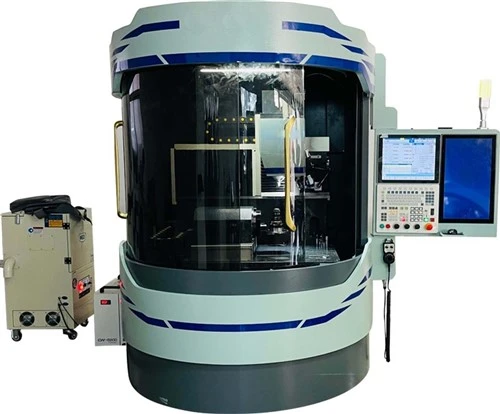

High Precision and Accuracy: Laser grinder can achieve very accurate dimensions and fine finishes, essential for parts requiring tight tolerances.
Versatility: It’s suitable for various materials, from metals to ceramics and polymers.
Improved Surface Finish: Laser grinder provides very fine finishes and smooth surfaces, vital for applications where surface roughness is critical.
Ability to Machine Hard Materials: Hardened metals and high-strength materials that are challenging to machine using other methods can be effectively ground.
Complex Shape Fabrication: Capable of producing intricate shapes and features like slots, grooves, and profiles.
No Burr Formation: Unlike some cutting processes, laser grinder does not leave burrs, reducing the need for secondary finishing processes.
Consistency and Reproducibility: Especially with CNC laser grinder machines, it offers consistent and repeatable results, crucial in mass production.
Limited Heat Generation: With proper coolant use, heat generation is minimal, reducing the risk of thermal damage to the workpiece.
Agricultural Industry
The agricultural industry is responsible for the large-scale cultivation of all livestock and crops. The scale of modern agriculture demands heavy machinery and equipment to efficiently produce large volumes of food. This includes planting machines, fertilizing machines, and bulk storage tanks. Many types of agricultural machinery are primarily made of flat, complex parts joined by welding or fasteners. Laser grinder is ideally suited to economically produce such components.
Military Industry
The military industry makes use of electronic equipment with advanced circuit boards and heavy-duty machinery. These types of machinery need to be produced to exacting specifications using modern, difficult-to-process materials like hardened steel, non-ferrous metals like titanium, fabrics like kevlar, and advanced super alloys like Inconel®. Laser grinder is an indispensable process for fabricating the tens of thousands of parts and products made every year to meet military quality standards.
Construction Industry
The construction industry builds large-scale projects such as bridges and tunnels, as well as residential and commercial buildings. Structural steel for these projects is often produced by laser grinder. For example, connection plates and base plates are most optimally manufactured by using laser grinder. There are often thousands of these components for a major steel construction project, so laser grinder’s speed and precision give it a big advantage in these applications.
Automotive Manufacturing Industry
The global automotive industry is a large consumer of manufacturing output, with over 80 million vehicles produced globally in 2022. The automotive industry requires parts that are precisely manufactured, with very little part-to-part deviation, while also maintaining high production rates to keep up with the pace of vehicle manufacturing. Laser grinder is an ideal technology for meeting the simultaneous requirements of pace, precision, and repeatability.
Musical Instruments Industry
Musical instruments must be manufactured with special precision to achieve the high level of sound quality demanded by professionals. Laser grinder is an ideal method for achieving unmatched levels of dimensional accuracy. Wood is a common material used in musical instruments, and laser grinders can be used to cut out the basic panels that will be assembled into instruments like guitars and violins, for example. The finished instruments can also be laser engraved with custom artistic patterns, adding cosmetic appeal and a personal style element.
Medical Equipment Industry
Medical diagnostic equipment such as X-ray and FMRI machines are complex pieces of equipment that employ a number of different manufacturing technologies. Laser grinder can be used to produce a number of components for these machines, such as their sheet metal housings.
Electronics Industry
Laser grinder is widely used in the electronics industry due to the precision required to process micron-scale electronics components. Silicon wafers are also cut using specialized laser grinder techniques such as fracture-controlled cutting. Other applications include laser engraving information onto components and drilling precise holes in printed circuit boards.
Furniture Industry
The furniture industry makes use of a range of materials such as textiles, wood, and plastics. laser grinder can cheaply process all of these materials, which is why it is a popular technology in this industry. Textile and padding patterns can be cut for upholstery, and wood can be engraved with various designs. MDF (Medium Density Fiberboard) wood panels can also be grinding to produce interesting furniture designs.
Laser Source
The laser source is the heart of the laser grinder, generating the high-energy laser beam that is used for material removal and grinding. Common laser sources used in laser grinders include CO2 lasers, fiber lasers, and diode-pumped solid-state (DPSS) lasers.
Optical System
The optical system consists of a series of mirrors, lenses, and other optical components that shape, focus, and direct the laser beam onto the workpiece. This includes a beam delivery system to transport the laser beam from the source to the work area.
Motion Control System
The motion control system precisely controls the movement of the laser beam or the workpiece relative to each other. This typically involves computer-controlled positioning stages, servo motors, and linear actuators.
Workpiece Handling System
The workpiece handling system secures and positions the material to be ground or processed by the laser. This may include a chuck, clamp, or other fixturing mechanism to hold the workpiece in place.
Cooling System
Laser grinders generate significant heat during operation, so an effective cooling system is essential to prevent overheating and maintain optimal performance. This may include air-based or liquid-based cooling systems, depending on the power and duty cycle of the laser.
Enclosure and Safety Features
Laser grinders are typically enclosed in a protective housing to contain the laser beam and prevent accidental exposure. Safety features, such as interlocks, emergency stops, and warning lights, are essential to ensure the safe operation of the laser grinder.
Control and User Interface
A computer-based control system manages the operation of the laser grinder, allowing users to set parameters, monitor performance, and troubleshoot issues. The user interface, which may include a touchscreen or other input devices, enables the operator to control and program the laser grinder.

Metal
Laser grinders are common in metalworking applications. They can cut, shape, and finish various types of metals, including: carbon steel, stainless steel, aluminum, brass, iron, titanium, Monel®, Inconel®, tool steels, and more. Metal grinding can give them precise dimensions, smooth surfaces, and sharp edges as necessary.
Concrete
Laser grinders are used for concrete grinding and polishing. They are commonly used in the construction and flooring industries to level, smooth, and prepare concrete surfaces. This process is essential for creating polished concrete floors, removing surface imperfections, and exposing aggregates for decorative purposes.


Tile
Laser grinders are used to cut and shape ceramic or porcelain tiles. Tile grinders are equipped with diamond or abrasive wheels designed to cut through tile materials accurately and give them clean edges. These machines are commonly used by tile installers and manufacturers to create precise tile shapes and sizes.
Stone
Natural and synthetic stones such as granite, marble, quartz, and engineered stone can be cut and shaped using laser grinders. Stone fabricators use these machines to create countertops, sculptures, monuments, and architectural elements. Grinding generates smooth edges and polished surfaces in stone products.

The laser grinder is a tool that’s primarily used for finishing operations, distinguished by its remarkable structural rigidity. It uses laser to execute precision grinding operations. This grinding process is essential for achieving the product’s desired shape and surface quality, as specified in the project's requirements. Typically, grinding follows roughing operations that remove the bulk of residual material from the workpiece. The subsequent grinding work eliminates any remaining excess material to create a finely finished surface.
laser grinders come in various types, each tailored to specific processing needs. These include: laser grinders for flat surfaces, cylindrical and conical surfaces (both internal and external), centerless grinders, and specialized machines for grinding screws and toothed wheels.
Structurally, a laser grinder comprises a base or pallet that supports the worktable and the vertical column. The bench houses mechanisms for controlling the table's longitudinal and transversal movement as well as a mount for the wheel spindle's motion. Longitudinal table movement is generated and controlled by an oleo-dynamic circuit, ensuring smooth and consistent motion despite gear transmission.
The wheel's motion may demand rotation around both horizontal and vertical axes. Vertical spindle orientation is suitable for quick and effective grinding using cup grinding wheels, although it may leave traces on the surface. In contrast, a horizontal spindle orientation utilizes disk wheels that, in addition to smoothing a part’s surface, can also machine longitudinal grooves and grooved shafts.

Every type of laser grinder affects workpieces differently. Your selection can make all the difference. One key factor is the surface finish. Precision machines like cylindrical or centerless grinders excel in achieving smooth, precise finishes, ideal for high-precision applications. Bench grinders, on the other hand, produce rougher finishes suited for less critical work. The choice of laser grinder also influences the rate at which material is removed from the workpiece. High-material-removal-rate machines are often crucial for heavy manufacturing.
The accuracy of the final product also depends on the specific laser grinder.
Precision laser grinders are engineered to meet the tight tolerances and high levels of accuracy demanded by aerospace and automotive manufacturing. Incorrect choices may lead to components failing to meet specified tolerances. Furthermore, the generation of heat during the grinding process is another important consideration, especially when working with heat-sensitive materials such as plastics or certain metals. Some machines feature cooling systems to counteract heat buildu
Make sure you’ve been properly trained
Proper training is key when using a laser grinder. Laser grinders include dangerous components, and it is important to know and understand the risks. The device’s manufacturer can often provide training. Training should cover the general hazards of laser grinder in addition to the detailed procedures and interlocks of your specific machine.
Never circumvent safety interlocks built into the cutter
Safety interlocks in laser grinders are integral to their functionality. The lasers themselves are usually class-3b or class-4 lasers. These classes are powerful enough to cause eye injuries if viewed directly (and sometimes even indirectly) and can potentially cause skin damage or fire. Due to the interlocks built into the laser grinder, however, they are generally sold as class-1 laser products.
When operating a laser grinder, always follow the manufacturer's instructions
The laser grinder’s manufacturer knows the limitations and inherent risks of their design. Each laser grinder will include certain interlocks and design features that are intended to keep users and equipment safe. Make sure to read through the safety and operating instructions after buying a new cutter. If the manufacturer has recommended limits or highlighted particular risks, it is important to take note and follow these guidelines.
Keep a logbook detailing who has used the laser grinder, the cutting time, and the materials cut
A logbook recording what materials have been cut and by whom can be important to safe operation. Some materials may leave flammable residue behind. Also, if anything seems unusual upon inspection of the cutter, the last person to use the machine can be consulted so the new operator knows what was in the machine last. A log of the laser’s operating hours can also be important so your shop can perform periodic maintenance on schedule.
A fire extinguisher should be mounted on the wall near the laser grinder
Fire is always a risk when operating a laser grinder. Some materials are more likely to catch fire than others. Since the laser, by design, melts, vaporizes, or burns material, fire is a preeminent possibility. A fire extinguisher must be clearly mounted in an easy-to-reach spot very near the laser grinder. It is equally important that access to the fire extinguisher is not blocked by clutter on the floor or by placing another machine in front of it.
Vacuuming the cutting deck and the internal cavity of the laser grinder on a regular basis is critical for fire prevention!
The buildup of dust within the laser grinder’s housing significantly increases the risk of a fire. Dust particles are naturally very small and therefore have a large surface-area-to-volume ratio. This allows large amounts of air (and oxygen) to be in contact with the particles at all times. As a result, dust ignites more easily than a solid block of the same material.
Understand what materials can be safely cut
Some materials are not safe to cut with a laser grinder. Usually, this is for one of two reasons: They have a high risk of causing a fire, or they release toxic fumes when struck by the laser. Take the precaution of researching each material before cutting. An example of an unsafe material is pvc plastic. When it is cut by a laser, the polymer decomposes to release hydrogen chloride gas.
Never leave a laser grinder running unattended
An operator should never leave a laser grinder unattended while it is running due to the risk of ignition. Fire is an ever-present possibility when working with high-powered lasers. The workpiece (or dust inside the machine from previous jobs) may ignite at any time during operation. If the laser grinder is supervised, quick action can immediately put out the fire — generally by using a co2 fire extinguisher at the base of the flame.
Laser grinders should not be used on wooden surfaces
Properly mount laser grinders on a firm, non-flammable surface such as a concrete or steel deck. Laser grinders should not be placed on wooden surfaces due to the risk of fire. Materials inside the machine may occasionally ignite, so all reasonable precautions should be taken to reduce the risk that such a fire could spread.
Learn how changing the laser's pulse rate affects the likelihood of a fire
Laser grinders use pulsing firing patterns to increase their peak optical energy. Rather than emitting a constant power output, a pulsed laser provides short bursts at higher power levels. The laser “stores” energy between pulses, so slower pulse rates (lower frequencies) generate more energy per pulse. Conversely, a higher pulse frequency will have lower peak energy
The safety gear that should be worn when using a laser grinder includes: laser safety glasses, a mask or respirator, and thick gloves. Laser safety glasses have specifically designed lenses that are tinted to absorb the laser’s light and prevent it from passing through to the wearer’s eyes. The glasses must be matched to the laser type (and wavelength) that you are using. They also tend to be different colors according to the wavelength they absorb: blue or green for diode lasers, gray for CO2 lasers, and light green for fiber lasers.
A respirator (a cartridge mask similar to those painters wear) is also an important piece of safety gear. Depending on the extraction systems and the material that is being cut, the operator may need additional lung protection. The cartridges should be selected to protect against vapors specific to the material being grinding. Most often, those are some form of organic vapors.
Thick gloves can also be useful when handling hot material that has just been grinding.
Our production base is in Shenzhen, Guangdong Province, equipped with advanced production facilities and modern production lines. We utilize advanced laser technology and 3D printing advantages to provide many enterprises with cost-effective solutions compared to traditional industrial production. The factory is staffed with optoelectronic technology experts, enabling us to serve customers from a professional perspective and solve a wide range of issues for them.

Q: What is the basic knowledge of laser grinder?
Q: What are the three types of laser grinders?
Q: What is the science behind laser grinder?
Q: How to operate a laser grinder?
Q: What is the rules and proper procedure of grinding?
Q: What are 5 safety practices when using the laser grinder?
Q: What materials cannot be ground on a grinding wheel?
Q: What is the rpm of a grinding machine?
Q: What is the most common injury when using a grinder?
Q: What should be avoided when grinding tools on the grinder?
Q: What should you check before using a grinder?
Q: How do you inspect a laser grinder?
Q: What is the safe work procedure for laser grinders?
Q: What must be the do's and don'ts when using a grinding machine?
Q: How to prevent laser grinder kickback?
We're professional laser grinder manufacturers and suppliers in China, specialized in providing high quality customized service. We warmly welcome you to buy discount laser grinder made in China here from our factory. Good service and low price are available.
Conformal cooling by SLM 3D Printing, 3D printing for the rapid prototyping of structural electronics, 3D Printing for Space(0/10)

