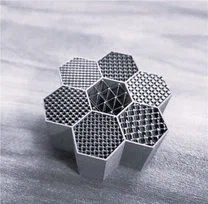
In recent years, 3D printed bicycle seat cushions have gradually emerged in the industry. Its advantages such as "comfort", "breathability", "zone shock absorption", and "no pressure" have become the favorite of many professional drivers and cycling enthusiasts' new favorite.
Constrained by the performance of a single material, traditional manufacturing has to choose a variety of materials to achieve the desired performance, including leather goods, bow materials, bottom shells, and foam materials, which in turn leads to multiple tedious and complicated production processes. A professional saddle manufacturer needs at least a dozen or even twenty processes to make a bicycle saddle without a bottom bow.
However, the lattice cushion made by 3D printing only needs "1" process in the production process. This advantage stems from the fact that 3D printing can use one material to achieve multiple material properties. It does not require large-scale mechanical equipment to open molds and press shapes, and can be directly printed and formed in one piece. More than a dozen processes including pouring, baking, cutting, and gluing The process is compressed into one - "printing". Moreover, 3D printing is additive manufacturing. The lattice structure in the 3D printed bicycle seat cushion produced by it is directly printed without cutting. Compared with the solid seat cushion, it not only reduces the weight, but also greatly reduces the use of materials and reduces the cost. It also increases the environmental index.

For 3D printed bicycle cushions with different buffer zones, different ranges of cushion load-bearing areas, and different use scenarios, the softness and hardness of different areas of the cushion can be changed by adjusting the lattice structure, so as to achieve the effects of "shock cushioning" and "comfort". The needs of different product categories in terms of support and comfort.
At the same time, it is precisely because of the online processing method that in the product verification stage, not only can the 3D printed bicycle seat be simulated online, but the 3D printed bicycle seat printed in one piece can be adjusted by software to adjust the lattice structure after the riding test. Quickly iterate to achieve a riding effect that combines performance and comfort.

In terms of quality, Qingfeng's self-developed high-elastic EM material can also provide a strong guarantee, which is better in physical properties such as resilience, tear resistance, and low temperature resistance. The midsole of the shoe printed by it can still be uncompromised after 1 million tests, and has the resilience of "as before".
Compared with ordinary bicycle seat cushions, 3D printed bicycle seat cushions are less prone to degumming, fracture, damage, etc. under sun exposure, low temperature and other environments, can withstand more severe environmental tests, and have a longer service life.