
In the national standard "GB 7247.1-2016 Safety of Laser Products," laser products are classified into 4 major classes and 7 levels (1, 1M, 2, 2M, 3R, 3B, 4) based on their wavelength and maximum output laser power. The standard's definition of laser wavelength is primarily intended to indicate whether the laser is visible (such as red, green, blue, etc.) or invisible. The definition of laser output power aims to warn users about the potential hazards when coming into contact with the laser, reminding users to pay attention to safety.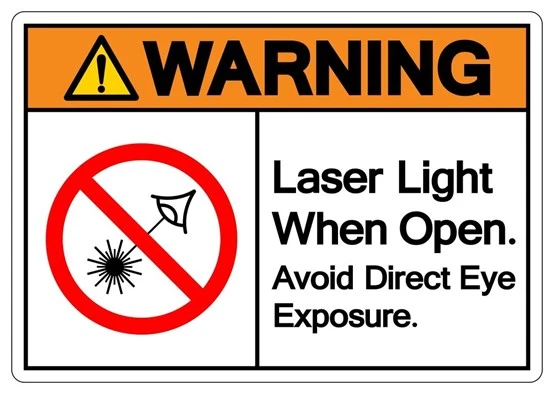
Class 1 Laser (1 Class, 1M Class) Laser Power: Less than 0.5 milliwatts, wavelength between 302.5 nm and 4000 nm, not necessarily visible laser. Class 1 lasers are considered risk-free as they do not pose a hazard to human health under normal usage conditions. However, these products must still ensure designs that prevent workers from entering the laser radiation area during operation.
Class 2 Laser (2 Class, 2M Class) Laser Power: Less than 1 milliwatt, wavelength between 400 nm and 700 nm. Lasers of this class are low-power, visible lasers. Human eyes can protect themselves from bright light by blinking. Under normal usage conditions, brief exposure to these lasers typically does not cause permanent damage to the eyes, but prolonged direct viewing can be hazardous. Warning labels should be affixed near the laser emission aperture for Class 2 lasers.
Class 3 Laser (3R Class, 3B Class) Class 3 lasers are further divided into 3R and 3B.
3R Class Laser: Laser Power: 1 milliwatt to 5 milliwatts. These lasers are considered low-risk but still pose a potential hazard to the eyes. Like Class 2 lasers, Class 3R lasers require warning labels at the laser emission aperture. Short-term exposure may allow the eye's protective reflex to mitigate some risk, but focused laser beams entering the eye can cause harm.
3B Class Laser: Laser Power: 5 milliwatts to 500 milliwatts. These lasers can cause harm if viewed directly or from diffuse reflections. Class 3B lasers typically have "Danger" labels. Although they pose a risk to the eyes, the danger of causing fires or skin burns is relatively low if the beam is not focused. It is recommended to wear protective eyewear when using Class 3B lasers.
Class 4 Laser
Laser Power: Above 500 milliwatts. Lasers of this class pose significant hazards to both eyes and skin. Direct, reflected, and diffuse reflections can cause injury. All Class 4 laser devices must have "Danger" labels. Class 4 lasers can also damage nearby materials and ignite flammable substances. When using this class of laser, protective eyewear is required, just as with Class 3B lasers.
From the above laser safety classifications, it can be seen that when choosing a laser positioning system, products labeled with Class 1 or Class 2 lasers should be selected. This means the laser output power should be less than 1 milliwatt to avoid eye damage during everyday use.


